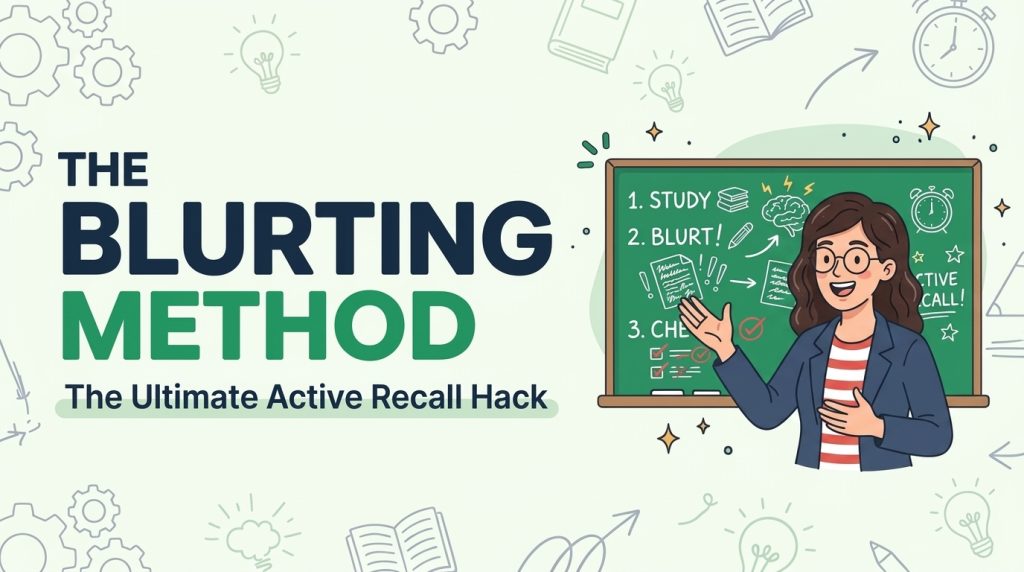
The Blurting Method is an active recall study technique in which a student reads a defined chunk of study material, closes all source notes, and writes down (“blurts”) everything remembered onto a completely blank canvas entirely from memory before performing a strict audit against the original text.
While popularized across digital platforms like StudyTok and YouTube (tracing back to student creator Unjaded Jade in 2017), its underlying cognitive mechanism is a century-old learning science principle known as written free recall or retrieval practice.
+------------------------------------------------------------------+
|                   RECOGNITION VS. FREE RECALL                    |
|                                                                  |
| Passive Recognition (Cued)       Active Free Recall (Unprompted) |
| [Notes / Highlights / Headers]   [Blank Page / Zero Prompts]     |
|              |                                 |                 |
|              v                                 v                 |
|  Creates "Illusion of Fluency"   Forces Memory Reconstruction    |
|   (Low 1-Week Retention ~20%)     (High 1-Week Retention ~60-80%) |
+------------------------------------------------------------------+
Traditional revision relies heavily on cued recognition, where highlighters, open textbooks, flashcard prompts, or section headers provide subtle cognitive clues. These cues trigger a feeling of visual familiarity, luring students into an “illusion of competence” or false fluency—the mistaken belief that recognizing a fact on paper translates to retrieving it during an exam.
In contrast, unprompted free recall strips away all external scaffolding. By forcing the brain to navigate its own neural networks and reconstruct complex knowledge structures from scratch on a blank page, blurting tests working memory capacity under retrieval-cue independence. This raw cognitive effort exposes exact knowledge gaps and builds resilient synaptic memory pathways.
Key Takeaways
- Unprompted Retrieval Practice: Blurting forces the brain to retrieve information without prompts, strengthening synaptic memory connections far more effectively than passive rereading or highlighting.
- The Multicolor Diagnostic Audit: The primary cognitive value of blurting occurs during the check phase—using a contrasting pen color to conduct a strict line-by-line comparison creates an immediate visual heat map of knowledge blind spots.
- Strategic System Integration: Blurting operates at its peak when paired with targeted gap-filling, flashcards for daily maintenance, and expanding spaced repetition intervals.
1. The Cognitive Science Behind Blurting: Why Retrieval Trumps Rereading
Decades of cognitive science research demonstrate that pulling information out of memory strengthens retention significantly more than re-exposing the brain to the same information.
1-WEEK RETENTION RATES BY STUDY TECHNIQUE
========================================================================
Passive Rereading        [██████████ 20%]
Highlighting             [███████████ 25%]
Summarizing              [████████████████████ 40%]
Retrieval Practice       [██████████████████████████████ 60%]
Blurting + Spaced Review [████████████████████████████████████████ 80%]
========================================================================
Source: Synthesized from Roediger & Karpicke (2006) and Dunlosky et al. (2013).
1.1 The Testing Effect (Roediger & Karpicke, 2006)
In a landmark 2006 study published in Psychological Science, researchers Henry L. Roediger III and Jeffrey D. Karpicke evaluated undergraduate students studying short science passages regarding the sun and sea otters. The study compared two main groups:
- Repeated Study Group: Studied the passage across four 5-minute study periods.
- Retrieval Practice Group: Studied the passage during one 5-minute period, followed by three consecutive free-recall tests (writing down what they remembered with zero feedback).
When tested 5 minutes later, the repeated study group performed higher (83% of idea units recalled versus 71% for the recall group). However, when tested 1 week later, the results flipped dramatically:
- The Retrieval Practice Group retained 61% of the material.
- The Repeated Study Group retained only 40%.
              ROEDIGER & KARPICKE (2006) RETENTION RESULTS
   100% |
        |      83%
    80% |     /    \  71%
        |    /       \_________________ 61% (Retrieval Group)
    60% |   /
        |  /
    40% | /---------------------------- 40% (Rereading Group)
        |___________________________________________________
              5 Minutes Later                1 Week Later
Across the experiment, the retrieval group read the passage an average of 3.4 times, whereas the rereading group read it 14.2 times. Despite reading the text over four times as often and expressing higher subjective confidence before the test, the rereading group experienced rapid memory decay. The mental effort of retrieving facts from memory provided a ~50% retention advantage over passive exposure.
1.2 Retrieval Practice vs. Elaborative Studying (Karpicke & Blunt, 2011)
A 2011 study by Karpicke and Blunt published in Science tested whether retrieval practice applied to higher-order learning and conceptual comprehension. Students studied science texts using either retrieval practice (free recall) or elaborative concept mapping with the text open.
One week later, students were evaluated on both factual questions and complex inference questions:
- Retrieval Practice Group: Scored 0.67 (mean proportion of correct answers).
- Concept Mapping Group: Scored 0.45.
In a head-to-head evaluation, 84% of students (101 of 120) performed better after retrieval practice than concept mapping. Yet prior to the test, 75% of these students (90 of 120) predicted that concept mapping would be superior.
The Metacognitive Illusion of Perceptual Fluency
Why do students consistently misjudge their own learning? This gap stems from perceptual fluency—a metacognitive illusion where low cognitive effort during open-book reading or concept mapping creates a false signal of mastery. When notes remain visible, visual processing speed is fast and effortless. The brain misinterprets this ease of processing as a signal of strong memory encoding. Conversely, unprompted free recall feels difficult, slow, and taxing. Students mistake this cognitive struggle for poor learning, when in reality, the strain of memory reconstruction is the exact signal triggering neural adaptation.
1.3 High Utility vs. Low Utility Study Techniques (Dunlosky et al., 2013)
A comprehensive educational review by Dunlosky and colleagues (2013) evaluated ten widely used learning strategies based on efficacy, generalizability, and ease of implementation:
- High Utility: Practice Testing (retrieval practice/blurting) and Distributed Practice (spaced repetition).
- Low Utility: Rereading, Highlighting, and Summarization (when performed passively with open notes).
1.4 Broader Scientific Consensus & Neurological Mechanisms
The superiority of retrieval practice is backed by extensive educational research:
- Yang et al. (2021): A meta-analysis of 222 classroom studies involving 48,478 students revealed that practice testing/quizzing consistently boosted academic achievement (g = 0.499).
- Agarwal et al. (2021): A review of 50 classroom experiments showed that 57% of effect sizes yielded medium or large benefits for student learning via retrieval practice.
- Adesope et al. (2017): Meta-analytic findings demonstrated that practice tests were significantly more beneficial for retention than restudying or control conditions.
- Xu et al. (2024): A systematic review in higher education confirmed active recall strategies (including flashcards and written recall) directly correlated with higher student GPAs and exam scores.
Neurological Mechanisms: Desirable Difficulties, Generation Effect, & Cortical Reconsolidation
- Desirable Difficulties (Bjork & Bjork, 2011): Cognitive conditions that make short-term retrieval feel effortful slow down immediate performance but trigger deep neural encoding, resulting in long-term memory formation.
- The Generation Effect (Slamecka & Graf, 1978): Information generated directly from one’s own memory pathways creates synaptic retention pathways up to three times stronger than passively consuming externally presented information.
- Cortical Memory Reconsolidation: Every time a trace is retrieved, memory becomes labile (temporarily malleable) before undergoings reconsolidation. Unprompted recall alters the original trace, integrating new contextual connections and reinforcing cortical pathway accessibility for future retrieval under pressure.
2. The 4-Step Blurting Protocol: Step-by-Step Guide
To execute a blurting session correctly, follow this structured, timeboxed workflow:
+-------------------------------------------------------------------+
|                     THE 4-STEP BLURTING LOOP                      |
|                                                                   |
| [Step 1: Read & Focus]  -->  [Step 2: Total Lockdown Blurt]       |
|      (10-15 Mins)                 (5-10 Mins / Blank Page)        |
|                                              |                    |
|                                              v                    |
| [Step 4: Targeted Re-Blurt] <-- [Step 3: Multicolor Audit]        |
|     (2 Mins / Gaps Only)           (5 Mins / Check vs Source Ink) |
+-------------------------------------------------------------------+
Step 1: Read & Focus (Isolate a Syllabus Slice)
- Action: Select a small, tightly bounded content chunk (e.g., one physiological pathway, one formula set, or a single historical event). Do not attempt to blurt a 50-page chapter at once.
- Timing: Spend 10–15 minutes reading actively to understand the underlying mechanics.
- Revision Stage Rule: As noted in guidelines from Birmingham City University (BCU), blurting is deployed most effectively during later revision stages after initial comprehension is established. Do not attempt to blurt brand-new material before grasping baseline concepts.
- Execution Rule: Read for understanding without highlighting, underlining, or copying notes.
Step 2: Total Lockdown Blurt (Unprompted Memory Dump)
- Action: Close all textbooks, flip physical notes face down, and hide digital screens. Place a blank sheet of paper in front of you.
- Timing: Set a strict timer for 5–10 minutes.
- Execution Rule: Write down everything remembered as quickly as possible. Use bullet points, rough text, equations, or structural diagrams. Do not stop to organize formatting, fix spelling, or erase mistakes. If memory stalls, write a question mark (
?) or leave a blank space and keep pushing until the timer expires. - Eco-Friendly Pro-Tip: High-volume blurting can generate significant paper waste. Invest in a mini dry-erase whiteboard to perform rapid memory dumps sustainably while eliminating physical setup friction during high-frequency revision blocks.
Step 3: Multicolor Audit (Diagnostic Heat Map)
- Action: Open source notes. Compare the blurted page line-by-line against the original material.
- Timing: Spend 5 minutes reviewing.
- Execution Rule: Use a contrasting pen color (e.g., red or purple ink over original black ink). Circle incorrect terms, fill in omitted steps, and refine vague explanations. This overlay creates a visual diagnostic “heat map” of knowledge blind spots.
SAMPLE MULTICOLOR AUDIT (BIOLOGY CONTENT CHUNK)
--------------------------------------------------------------------
Glycolysis occurs in cytoplasm. Split glucose to 2 pyruvate.
Yields net 2 ATP and NADH.
[RED INK AUDIT]: Missing Link Reaction: Pyruvate -> Acetyl-CoA + CO2.
Krebs Cycle occurs in mitochondrial matrix (NOT cytoplasm!).
Yields ATP, CO2, NADH, and [RED INK AUDIT]: FADH2.
ETC needs oxygen -> [RED INK AUDIT]: Oxygen is the final electron acceptor
on the inner mitochondrial membrane.
--------------------------------------------------------------------
Step 4: Targeted Re-Blurt (Closing the Gaps)
- Action: Re-study only the red-ink corrections. Do not reread mastered material.
- Timing: Set a timer for 2 minutes.
- Execution Rule: Hide the notes once more. On a clean section of the page, blurt only the corrected gap items until retrieval is fast and accurate.
3. Subject-Specific Blurting Workflows
Adapting the Blurting Method across academic fields requires adjusting the structure of what is retrieved:
STEM & Mathematics
- Primary Focus: Formula sets, variable units, discriminant rules, process logic, and reaction mechanisms.
- Execution Rule: Retrieve formula structures, unit conversion factors, and operational conditions from memory.
- Quantitative Retrieval Benchmark: Target an automatic formula retrieval speed of under 3 seconds per equation to prevent cognitive stalls during timed standardized test trap questions.
- Note: Do not blurt complex problem derivations or multi-step proofs, which require active, procedural problem-solving practice. For example, in SAT Math, blurt formulas not included on reference sheets (distance, midpoint, slope, exponent rules, and vertex forms).
SAT MATH FORMULA BLURT UNIT
-------------------------------------------------------------------
Vertex Form: y = a(x - h)^2 + k  [Watch Sign Trap: (x - h), not (x + h)]
Discriminant: b^2 - 4ac
  * b^2 - 4ac > 0  --> 2 Real Roots
  * b^2 - 4ac = 0  --> 1 Real Root
  * b^2 - 4ac < 0  --> No Real Roots (Complex)
-------------------------------------------------------------------
Humanities & Social Studies
- Primary Focus: Argument structures (claim-evidence-warrant), thesis frameworks, theoretical models, and core concepts paired with theoretical criticisms.
- Execution Rule: Retrieve conceptual frameworks and supporting evidence logically. In Psychology, blurt a core theory, its main claim, and a primary criticism.
History & Political Science
- Primary Focus: Chronological sequences, cause-and-effect chains, dates, names, key event terminology, and treaty clauses.
- Execution Rule: Connect discrete facts into a logical historical chain. For AP US History, blurt causes alongside structural thesis claims: \text{Treaty of Versailles Terms} \longrightarrow \text{Economic Consequences} \longrightarrow \text{Political Vacuum (Rise of Totalitarianism)}
Foreign Languages
- Primary Focus: Vocabulary clusters, verb conjugation tables, and sentence patterns.
- Execution Rule: Use the “3-Part Blurt Unit”: \text{Target Word/Phrase} \longrightarrow \text{Direct Translation} \longrightarrow \text{Original Example Sentence}
English & Reading
- Primary Focus: Literary device definitions, essay argument frameworks, and active passage analysis rules.
- Tactical Application: Execute a 5-Minute Active Reading Warm-Up prior to attempting SAT/AP practice passages. Blurting question-type strategy steps immediately before reading primes active analytical processing instead of passive scanning.
4. Real-World Case Studies & Worked Examples
4.1 Case Study 1: Cellular Respiration (Biology)
- Step 1 (Read): Read notes covering glucose conversion to \text{ATP} (10 minutes).
- Step 2 (Initial Blurt): Close notes. Set a 5-minute timer and write:
“Glycolysis happens in cytoplasm. Glucose gets split into two pyruvate. Small net \text{ATP} gain, and \text{NADH}. Pyruvate goes into mitochondria. Krebs cycle in cytoplasm makes \text{ATP}, \text{CO}_2, and \text{NADH}. Electron transport chain makes most \text{ATP}. Needs oxygen.”
- Step 3 (Multicolor Audit): Compare against textbook with a red pen:
- Error Detected: Krebs cycle occurs in the mitochondrial matrix, not the cytoplasm.
- Missing Detail: Omitted the link reaction (pyruvate converts to acetyl-\text{CoA}, releasing \text{CO}_2).
- Missing Detail: Omitted \text{FADH}_2 production in the Krebs cycle.
- Vague Statement: “Needs oxygen” \rightarrow Oxygen acts as the final electron acceptor on the inner mitochondrial membrane.
- Step 4 (Re-Blurt & Action): Re-blurt the link reaction and electron transport chain details on a blank space. Convert all red-ink gaps into flashcards for daily review.
4.2 Case Study 2: Quadratic Formulas & Sign Traps (SAT Math)
- Step 1 (Read): Review quadratic formula, vertex form y=a(x-h)^2+k, and discriminant rules (b^2-4ac).
- Step 2 (Initial Blurt): Close notes. Write formulas and discriminant rules:
“Formula: x = \frac{-b \pm \sqrt{b^2-4ac}}{2a}. Vertex: y=a(x+h)^2+k. Discriminant b^2-4ac > 0 \to 2 real roots, = 0 \to 1 root, < 0 \to no real roots.”
- Step 3 (Multicolor Audit): Compare against reference sheet.
- Error Detected: Wrote y=a(x+h)^2+k instead of y=a(x-h)^2+k. This sign flip is a common trap on standardized tests.
- Step 4 (Gap-Fill): Write the correct vertex equation 5 times, execute a 2-minute targeted re-blurt, and secure formula retrieval latency (< 3 seconds).
4.3 Case Study 3: Rhetorical Terms (AP English / SAT Reading)
- Step 1 (Read): Review ethos, pathos, logos, anaphora, and antithesis.
- Step 2 (Initial Blurt – Advanced Level): Write each term, its definition, and an original example sentence.
- Step 3 (Multicolor Audit): Compare against source terms.
- Error Detected: Antithesis definition was incomplete (forgot “within a balanced grammatical structure or clause”).
- Missing Detail: Could not generate an original example sentence for anaphora under pressure.
- Step 4 (Gap-Fill): Re-study antithesis, write 3 original example sentences for anaphora, and re-blurt all terms cleanly.
5. Comprehensive Method Comparison: Blurting vs. Alternatives
| Study Method | What It Trains | Retention After 1 Week | Effort Level | Best Used For |
| Blurting (Retrieval Practice) | Active recall, structural memory connections, & unprompted output | High (~60–80%) | Medium-High | Conceptual facts, formulas, vocabulary, grammar rules, structural sequences. |
| Flashcards | Cued recall, isolated recognition, & discrete paired associations | Good (~50–70%) | Medium | Isolated vocabulary, definitions, single equations, paired facts. |
| Practice Papers / Problem Sets | Procedural application, problem-solving execution, & exam timing | Good (~60–75%) | High | Mathematical execution, analytical essays, timed exam conditions. |
| Passive Rereading | Visual recognition & familiarity (creates illusion of fluency) | Low (~20–40%) | Low | Initial exposure only. Not recommended for retention. |
| Highlighting / Underlining | Visual identification of text on a page | Very Low (~25%) | Low | Passive scanning. Not recommended for retention. |
Strategic Integration: The Hybrid Study Stack
Maximize study efficiency by combining techniques into a structured pipeline:
+-------------------------------------------------------------------+
|                      THE HYBRID STUDY STACK                       |
|                                                                   |
| [Phase 1: Blurting]   --> Exposes structural knowledge gaps       |
|          |                                                        |
|          v                                                        |
| [Phase 2: Flashcards] --> Converts gaps into spaced review units  |
|          |                                                        |
|          v                                                        |
| [Phase 3: Practice]   --> Applies locked-in facts under exam time |
+-------------------------------------------------------------------+
- First Phase — Blurting: Execute a blurting session on a subtopic to construct factual foundations, establish structural connections, and expose exact memory gaps.
- Second Phase — Flashcard Conversion & Diminishing Cues: Take red-ink audit gaps and convert them into discrete flashcards for daily maintenance via spaced repetition. To accelerate gap closure, build diminishing-cue cloze cards (Fiechter & Benjamin, 2017), which utilize fading letter prompts to guide retrieval without providing the full answer—a technique shown to boost memory retention by 44%.
- Third Phase — Application: Complete practice papers or problem sets under timed conditions to apply locked-in facts to complex exam questions.
6. 5 Critical Blurting Pitfalls (And How to Fix Them)
Pitfall 1: Peeking Mid-Blurt
- The Problem: Glancing at notes when memory stalls. Peeking converts active retrieval into passive recognition, interrupting neural pathway encoding.
- The Fix: Place notes out of physical reach, turn digital screens off, or use a cover sheet. When stuck, write a
?, leave a gap, and keep pushing until the timer expires.
Pitfall 2: Over-Chunking (Macro-Blurting)
- The Problem: Attempting to blurt an entire textbook chapter or full semester’s worth of content in one sitting. This produces chaotic, incomplete output, resulting in cognitive overload and burnout.
- The Fix: Restrict blurting sessions to isolated content chunks (15–20 minutes of study material, a single physiological pathway, or one historical event).
Pitfall 3: Loose Auditing & Skipping Feedback (The Risk of Error Rehearsal)
- The Problem: Completing a memory dump and moving on without performing a systematic audit against source materials. From a neuroscientific perspective, uncorrected free recall carries a severe danger: Error Rehearsal. Retrieving incorrect facts without feedback triggers cortical memory reconsolidation of the false information, actively strengthening incorrect neural pathways. As cognitive scientists note, “a confident wrong explanation is still wrong.”
- The Fix: The audit is mandatory. Use a contrasting pen color (red or purple ink) to conduct a strict line-by-line comparison against your source text, explicitly overriding and reconsolidating errors with verified facts.
Pitfall 4: Rereading Everything During Gap-Fill
- The Problem: Re-reading the entire study chapter after auditing, which wastes time and reverts to passive study habits.
- The Fix: Re-study only the red-ink gaps, close the notes, and execute a targeted 2-minute re-blurt immediately.
Pitfall 5: The “One-and-Done” Attempt
- The Problem: Blurting a topic once and assuming it is permanently locked into long-term memory. Memory decays naturally over time without maintenance.
- The Fix: Pair blurting with spaced repetition. Re-blurt the same topic across expanding time intervals (e.g., Day 1, Day 3, Day 7, Day 14).
SPACED REPETITION SCHEDULE FOR BLURTING REPEATS
-------------------------------------------------------------------
[Day 1: Initial Blurt] ---> [Day 3: Second Blurt] ---> [Day 7] ---> [Day 14]
(Identifies initial gaps)   (Shrinks gap list)          (Locks memory)
-------------------------------------------------------------------
7. Frequently Asked Questions (FAQ)
Q: What is the primary difference between active recall and passive review?
A: Passive review involves looking at material (rereading, highlighting, re-watching lectures) where the source material does the cognitive work. Active recall forces the brain to retrieve answers from memory without prompts before looking at the source.
Q: Is blurting the same thing as retrieval practice?
A: Yes. Retrieval practice is the scientific research term for pulling information from memory. Blurting is a specific, student-facing, written free-recall implementation of retrieval practice performed on a blank page.
Q: How long and how frequent should blurting sessions be?
A: A single blurting cycle (read \to blurt \to audit \to gap-fill) takes 10–20 minutes per topic. Limit total sessions to 30–45 minutes max, as unprompted free recall is cognitively demanding and causes mental fatigue if extended too long.
Q: Does blurting work for math and calculation-heavy subjects?
A: Blurting works well in quantitative subjects for recalling formulas, variable units, discriminant rules, and operational process steps. However, it cannot replace solving actual practice problems, which trains procedural problem-solving skills.
Q: Can blurting replace reading textbook chapters or attending lectures?
A: No. Active recall tests and strengthens information that has already been comprehended. Blurting is deployed most effectively in later revision stages after initial learning and baseline understanding are established. Blurting replaces rereading, not initial learning.