
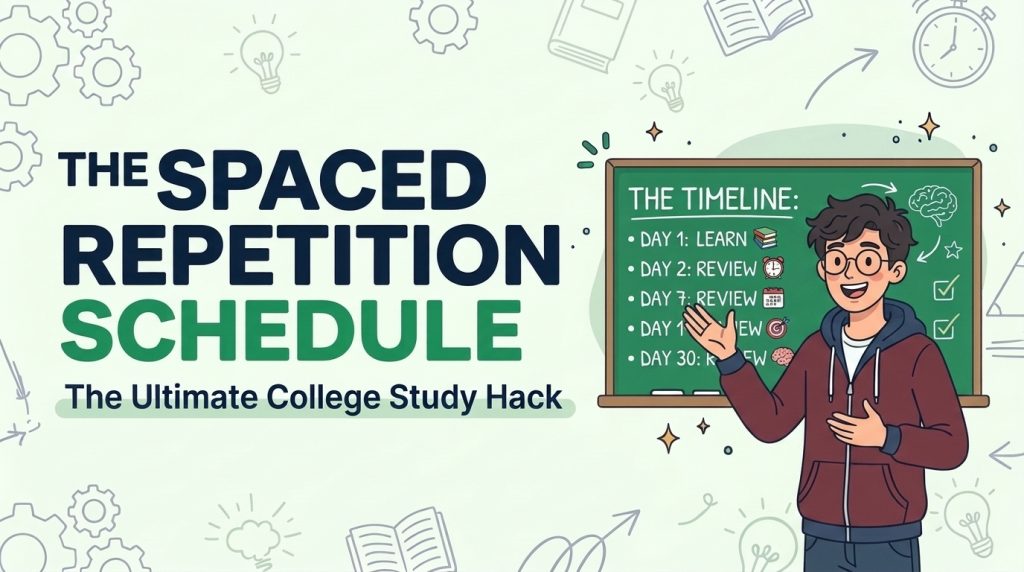
Undergraduate and professional education is frequently characterized as “drinking from a firehose.” Traditional undergraduate study routines—such as highlighting lecture slides, copying notes verbatim, or passively rereading textbook chapters—fail systematically because they produce a deceptive cognitive phenomenon known as the illusion of competence. Rereading generates perceptual fluency; because the material appears familiar upon visual re-exposure, the learner misinterprets this recognition as true mastery. However, visual recognition while looking at a page is neurologically distinct from retrieving that same information unprompted under exam conditions.
To build durable, long-term memory structures, higher-education learning relies on the integration of two evidence-based cognitive strategies:
- Active Recall (Retrieval Practice / The Testing Effect): The deliberate practice of retrieving knowledge from memory without looking at the source material. Rather than passively re-exposing the brain to information, the learner confronts a prompt, forcing the neural architecture to reconstruct the memory trace cold. Implementing rigorous Active Recall Techniques induces “neuroplastic friction”—the productive retrieval struggle that directly signals the brain to strengthen synaptic connections and consolidate memory traces.
- Spaced Repetition (Distributed Practice): The systematic scheduling of retrieval practice sessions at exponentially expanding time intervals (e.g., 1 day, 3 days, 7 days, 14 days). By timing reviews to occur precisely when a memory trace approaches its inter-review decay threshold, learners refresh knowledge at the point of maximum cognitive benefit, preventing transience while minimizing total study time.
| Parameter | Passive Review (Highlighting / Rereading) | Active Spaced Retrieval |
| Cognitive Effort | Low (creates artificial perceptual fluency) | High (engages deliberate neuroplastic friction) |
| Exam Recall Reliability | Low to Moderate (vulnerable to familiarity traps) | Exceptional (builds durable hippocampal-neocortical networks) |
| Time Efficiency | Poor (requires continuous, repetitive cram blocks) | High (optimizes total study hours via targeted interstudy gaps) |
| Diagnostic Clarity | Conceals conceptual blind spots | Instantly isolates precise knowledge gaps |
1. Flattening the Ebbinghaus Forgetting Curve
In 1885, Dr. Hermann Ebbinghaus published foundational empirical research quantifying the mathematical trajectory of memory decay over time. His findings revealed that human memory decay follows an exponential curve: transience begins immediately following initial learning, with the steepest drop occurring within the first 24 hours.
Ebbinghaus Baseline Retention Statistics
- 20 minutes post-learning: 58.2% retention
- 1 hour post-learning: 44.2% retention
- 9 hours post-learning: 35.8% retention
- 1 day post-learning: 33.7% retention
- 2 days post-learning: 27.8% retention
- 6 days post-learning: 25.4% retention
Memory Retention (%)
100% |---[Touch 1]---[Touch 2]---------[Touch 3]------------------[Touch 4]----
     |  \           / \               / \                        /
 75% |   \         /   \             /   \                      /
     |    \       /     \           /     \                    /
 50% |     \_____/       \_________/       \__________________/   <- Reset & Flattened Trajectories
     |     (Day 1)        (Day 3)           (Day 7)              (Day 14+)
  0% +---------------------------------------------------------------------------- Time Elapsed
Active spaced repetition counteracts this biological decay curve. As shown in the multi-curve reset diagram above, each successful active retrieval touchpoint resets the retention level back to 100%. Crucially, every successful retrieval modifies the decay constant, progressively flattening the trajectory of subsequent forgotten material and extending the duration the memory trace remains retrievable.
While the mathematical reality of memory decay demonstrates how rapidly unreinforced knowledge is lost, robust cognitive science research provides the exact empirical framework required to solve it.
2. Cognitive Science & Evidence Base
2.1. The “Desirable Difficulty” Principle
Memory is not a static recording device; it is a dynamic biological system requiring targeted effort to drive structural re-consolidation. Coined by cognitive psychologist Dr. Robert Bjork, the principle of Desirable Difficulty posits that learning conditions that make performance during initial practice more challenging paradoxically lead to superior long-term retention and transfer.
If a concept is reviewed too soon after initial exposure, retrieval is effortless, generating negligible neuroplastic friction and minimal memory growth. Conversely, if review is delayed too long, the memory trace decays completely, forcing the learner to re-encode the material from scratch.
Optimal cognitive consolidation occurs at the verge of forgetting. When self-assessing retrieval quality using flashcard interface buttons or rating scales, selecting “Hard” or struggling for 5 to 10 seconds before flipping a card forces the brain through intense retrieval effort. This neuroplastic friction stimulates synaptic plasticity far more effectively than rapid peeking, maximizing the biological return on time invested.
2.2. Higher Education & Medical Board Study Syntheses
Empirical research across medical board examinations and undergraduate STEM courses validates distributed active retrieval over massed practice (cramming).
- UNLV Kirk Kerkorian School of Medicine CBSE Study: Research evaluating medical student performance on the Comprehensive Basic Science Examination (CBSE) revealed that students who maintained an above-average volume of “mature cards” (defined as flashcards with review intervals exceeding 21 days) achieved a mean exam score of 71.5%, compared to 60.0% for students with below-average mature card counts.
- Voice & Stirton (2020) STEM Trial: A controlled trial investigating undergraduate STEM education demonstrated that students utilizing active spaced repetition achieved the highest average exam performance at 70%, significantly outperforming control groups relying on traditional massed review routines.
- Cepeda et al. (2006): A comprehensive meta-analysis reviewing 184 empirical research articles across interstudy intervals confirmed that systematically expanding the time between study sessions directly correlates with elevated long-term memory retention.
- Augustin (2014): Published in The Yale Journal of Medicine and Biology, this synthesis established that active self-testing combined with interval-spaced repetition forms the single most efficient learning strategy for mastering high-volume medical curricula.
- Dobson (2012): A trial published in Advances in Physiology Education compared uniform review practice against expanding retrieval practice for physiology content. The results confirmed that expanding interstudy gaps (e.g., 1, 3, 7, 14 days) produced superior long-term recall compared to uniform, fixed review gaps.
| Study / Author | Domain | Core Finding | Impact on Learner Strategy |
| UNLV School of Med. | Medical (CBSE Exam) | Mature cards (>21-day interval) yielded 71.5% vs. 60.0% mean score. | Prioritize pushing flashcard review intervals past the 21-day threshold. |
| Voice & Stirton (2020) | Undergraduate STEM | Spaced repetition cohort achieved a top-tier average exam score of 70%. | Replace massed single-session study blocks with expanding pass schedules. |
| Cepeda et al. (2006) | Meta-Analysis (184 Papers) | Systematically expanding interstudy intervals elevated long-term retention. | Expand time gaps between subsequent review touches systematically. |
| Augustin (2014) | Medical Education | Active self-testing + interval review optimized knowledge retention. | Replace passive rereading with systematic active retrieval queues. |
| Dobson (2012) | Physiology Education | Expanding retrieval practice significantly outperformed uniform practice. | Shift from fixed-interval daily reviews to expanding interval schedules. |
Understanding these empirical findings allows us to analyze the algorithmic schedulers engineered to automate expanding review intervals.
3. Algorithm Deep-Dive: FSRS vs. SM-2 vs. Leitner
To execute spaced repetition efficiently across thousands of academic concepts, learners rely on scheduling frameworks ranging from modern machine-learning models to classic physical card systems.
       [ Evolutionary Progression of Repetition Schedulers ]
┌──────────────────────────────────────────────────────────────────┐
│  Leitner System (1972) - Physical Box Logic & Coarse Intervals   │
└─────────────────────────────────┬────────────────────────────────┘
                                  ▼
┌──────────────────────────────────────────────────────────────────┐
│  SM-2 Algorithm (1987) - Heuristic EF Multiplier & Universal Curves│
└─────────────────────────────────┬────────────────────────────────┘
                                  ▼
┌──────────────────────────────────────────────────────────────────┐
│  FSRS (2022+) - DSR Model Trained via Gradient Descent           │
└──────────────────────────────────────────────────────────────────┘
3.1. FSRS (Free Spaced Repetition Scheduler)
Developed beginning in 2022 by Jarrett Ye and the open-source open-spaced-repetition community, FSRS represents the state of the art in mathematical memory modeling. FSRS discards rigid universal heuristic formulas in favor of a personal statistical model fit to an individual user’s review history via gradient descent.
The DSR Memory Model
FSRS tracks three dynamic parameters for every individual card:
- Difficulty (D): Scaled from 1 to 10, measuring inherent card complexity based on user response ratings (Again, Hard, Good, Easy).
- Stability (S): The exact duration (in days) required for the probability of recall to drop to the user’s defined target retention rate.
- Retrievability (R): The real-time mathematical probability of successfully recalling the card, calculated as a function of current Stability (S) and elapsed time (t): R(t, S) = \left(1 + C \cdot \frac{t}{S}\right)^{-1}
Across a benchmark dataset of 727 million reviews from 10,000 Anki users, FSRS predicted recall with significantly higher accuracy than legacy algorithms. Developers estimate that FSRS achieves the same target retention rate with 20% to 30% fewer total reviews compared to SM-2. Furthermore, FSRS allows learners to set an explicit Desired Retention Target (typically parameterized between 0.80 and 0.97).
Cold-Start Requirement: FSRS requires approximately 1,000 historic card reviews to fit its 19+ personalized parameters accurately via gradient descent. Prior to reaching this 1,000-review cold-start threshold, FSRS defaults to generic parameters that perform comparably to SM-2.
3.2. SM-2 (SuperMemo 2)
Created by Piotr Woźniak in 1987, SM-2 served as the digital standard for over three decades and remains the default scheduler in classic distributions of Anki and RemNote.
SM-2 tracks two variables per card:
- Ease Factor (EF): A floating-point multiplier initialized at 2.5.
- Interval: The current review gap in days.
Upon a successful pass (Good or Easy), SM-2 multiplies the previous interval by the card’s EF, modifying the EF slightly based on rating difficulty. A failed card (Again) forces the interval to reset immediately to Day 1.
SM-2 Default Programmatic Sequence:
Day 1 ──> Day 6 ──> Day 15 ──> Day 37 ──> Day 92
Algorithmic Nuance: Note the structural distinction between Piotr Woźniak’s theoretical research baseline sequence derived in his early memory studies—1 day -> 7 days -> 16 days -> 35 days—and SM-2’s programmed software implementation defaults (1d -> 6d -> 15d -> 37d -> 92d). While simple and functional from card 1, SM-2 applies universal curve multipliers across all subjects, failing to adapt dynamically to distinct card difficulties or individual retention goals.
3.3. The Leitner Box System (Physical Paper Method)
Introduced by German science journalist Sebastian Leitner in 1972, this physical card system utilizes labeled compartments (boxes) to schedule paper flashcards without digital software.
- Core Rules: All new cards begin in Box 1. When answered correctly during a review session, a card advances to the next higher box. If answered incorrectly, it immediately resets to Box 1, regardless of its prior position.
[Box 1: Daily] ──(Correct)──> [Box 2: Every 2d] ──(Correct)──> [Box 3: Every 4d]
      ▲                                                              |
      └───────────────────────────(Incorrect)────────────────────────┘
- 3-Box Configuration: Box 1 (Daily), Box 2 (Every 2 days), Box 3 (Every 4 days).
- 5-Box Configuration: Box 1 (Daily), Box 2 (Every 2 days), Box 3 (Every 4 days), Box 4 (Every 8 days), Box 5 (Every 16 days).
- 7-Box Configuration: Box 1 (Daily), Box 2 (Every 2 days), Box 3 (Every 4 days), Box 4 (Every 8 days), Box 5 (Every 16 days), Box 6 (Every 32 days), Box 7 (Every 64 days).
3.4. Algorithm Decision Framework
| Feature / Parameter | FSRS (Free Spaced Repetition Scheduler) | SM-2 (SuperMemo 2) | Leitner Box System |
| Underlying Engine | Machine Learning (DSR Model) | Fixed EF Multiplier Formula | Physical Box Rules |
| Cold-Start Threshold | Requires ~1,000 reviews for full optimization | 0 reviews (Works instantly) | 0 reviews (Works instantly) |
| Review Efficiency | Maximum (20–30% fewer total reviews) | Baseline (Standard workload) | Low (Coarse scheduling intervals) |
| Adaptability | Personal fit per card via gradient descent | Universal curve across all decks | Static box intervals |
| Retention Target | Explicitly adjustable (0.80–0.97) | Implicit (~85%, non-configurable) | Non-configurable |
| Optimal Deck Size | Large (1,000+ cards) | Any size (1 to 10,000+ cards) | Small to Moderate (<500 cards) |
With algorithmic models providing the structural framework for interval expansion, students can translate these mechanics into practical weekly study schedules.
4. Practical Schedules & Templates
4.1. The 5-Touch Review Model
For students organizing study schedules manually or structuring weekly routines alongside software, the 5-Touch Review Model provides an actionable timeline for converting raw lecture content into durable knowledge.
Touch 1 (Day 0)  ──>  Touch 2 (Day 1)  ──>  Touch 3 (Day 3)  ──>  Touch 4 (Day 7)  ──>  Touch 5 (Day 14+)
 Lecture/Cues          10-Min Retrieval         Weak-Spot Focus         Mixed Review         Exam Simulation
- Touch 1 (Day 0 / Within 5 Hours): Attend initial lecture or complete assigned reading. Within 5 hours, convert key points into atomic practice questions or flashcards rather than highlighting.
- Touch 2 (Day 1 / 24 Hours Later): Conduct a 10-minute active retrieval session. Attempt to answer all new cues cold. Tag and isolate missed items.
- Touch 3 (Day 3 / 72 Hours Later): Re-test all missed items from Touch 2, followed by a pass over correct items plus 5 random concepts from prior units.
- Touch 4 (Day 7 / 1 Week Later): Perform a cumulative pass covering all active unit material using randomized, interleaved question order.
- Touch 5 (Day 14+ / 2 Weeks Later): Complete a timed maintenance retrieval set under exam conditions. Items missed at this stage return to Day 1.
4.2. 7-Day Weekly Study Calendar Matrix
The following structured matrix provides a daily schedule for balancing new lecture intake with expanding spaced reviews across a multi-course load:
| Day | Primary Session Focus | Spaced Review Block | Recommended Time |
| Monday | New Lecture Intake & Practice Cue Creation | Review due items from previous week’s queue | 45–60 mins |
| Tuesday | Day-1 Review of Monday’s material | Isolate and drill missed cards from Monday | 30 mins |
| Wednesday | New Lecture Intake & Cue Conversion | Review Tuesday’s designated weak-spot queue | 45 mins |
| Thursday | 72-Hour Review (Monday + Tuesday content) | Interleave 5 random questions from prior units | 25 mins |
| Friday | New Lecture Intake & Practice Sets | Cumulative mixed pass over all active week units | 50 mins |
| Saturday | Dedicated Backlog Catch-up Block | Clear overdue cards; rewrite “leech” cards | 20 mins |
| Sunday | Rest & Light Maintenance | 15-minute recall pass over week’s hardest terms | 0–15 mins |
When integrated alongside systematic Exam Countdown Planning, students can ensure high-priority units receive sufficient Touch 4 and Touch 5 passes prior to major midterms.
4.3. Subject-Specific Review Frequency Matrix
Different academic subjects decay in memory at distinct rates. Rote factual material requires tighter initial review intervals, whereas conceptual frameworks can sustain wider review gaps once understood.
| Subject Domain | Decay Rate | Initial Interval | Target Maturity Goal | Optimal Algorithm Alignment |
| Foreign Language / Rote Vocab | Rapid / Steep | Day 1 \rightarrow Day 3 | \ge 21 Days | FSRS / Anki: High-frequency atomic cards benefit from dynamic per-card difficulty tracking. |
| Medical / High-Volume Anatomy | Rapid / High Volume | Day 1 \rightarrow Day 2 | \ge 21 Days | FSRS / StudyGlen: Heavy review volume necessitates FSRS’s 20–30% review workload reduction. |
| STEM / Formula Mathematics | Moderate / Hybrid | Day 1 \rightarrow Day 4 | \ge 30 Days | SM-2 / RemNote: Blends formula recall cards with step-by-step problem-solving sets. |
| Physics / Conceptual Engineering | Slow (Post-comprehension) | Day 1 \rightarrow Day 7 | \ge 30 Days | Leitner (5-Box) / Anki: Long gaps permitted once core relational frameworks solidify. |
4.4. Note-Based Spaced Repetition (Yuhimo / Cornell Approach)
Not all academic material needs to be atomized into flashcards. Whole-page notes (such as Cornell Note pages) can be integrated directly into a spaced repetition schedule.
┌────────────────────────────────────────────────────────────────────────┐
│ CORNELL / YUHIMO NOTE PAGE LAYOUT                                      │
├──────────────────────────────────┬─────────────────────────────────────┤
│ RECALL CUES & MARGIN QUESTIONS   │ FULL CONCEPT LECTURE NOTES          │
│ * What controls max-age?         │ Cache-Control headers specify...    │
│ * How does ETag revalidate?      │ HTTP caching revalidates via...     │
├──────────────────────────────────┴─────────────────────────────────────┤
│ SELF-ASSESSMENT: [ ] Forgot  [ ] Barely  [ ] Remembered  [ ] Easily    │
└────────────────────────────────────────────────────────────────────────┘
- Structured Note Setup: Maintain full-page notes, placing explicit recall questions in the cue column/margins.
- Retrieval Practice Routine: When a note page becomes due, cover the main text area. Read the margin cues and attempt to explain or reconstruct the concept aloud before uncovering the text.
- Operational Self-Assessment Scale & Multipliers:
- Forgot: Minimal recall achieved; applies a 1-day interval (resets the page to Day 1 for immediate re-testing).
- Barely: Recalled partially with significant struggle; applies a neutral multiplier (\sim 1.0\times–1.2\times), maintaining current schedule.
- Remembered: Recalled core ideas successfully; applies a standard growth multiplier (\sim 2.0\times), doubling the review gap.
- Easily: Effortless recall; applies an aggressive expansion multiplier (\sim 3.0\times+), tripling or quadrupling the review gap.
Managing expanding study schedules across heavy academic course loads requires intentional strategies to prevent burnout and review accumulation.
5. Burnout Prevention & Course Load Management
5.1. Time-Blocking & Focus Sprints
To maintain consistency without cognitive fatigue, integrate spaced repetition queues into scheduled daily time blocks:
- Pomodoro Focus Sprints: By integrating Pomodoro Time-Blocking into daily routines, students work in 25-minute focused retrieval sprints followed by strict 5-minute cognitive breaks, completing a longer 15- to 30-minute rest after four sprints.
- Leveraging “Gap Hours”: Utilize non-contiguous campus downtime—such as a 30-minute break between lectures—to clear daily review queues on a mobile device.
5.2. Academic Prioritization via the Eisenhower Matrix
When course demands escalate, systematically organize study tasks using four distinct operational quadrants:
                  URGENT                        NOT URGENT
        ┌────────────────────────────┬────────────────────────────┐
        │ QUADRANT 1: DO NOW         │ QUADRANT 2: SCHEDULE       │
IMPORTANT│ * Upcoming midterms        │ * Flashcard cue creation   │
        │ * Daily due review queue   │ * Expanding long intervals │
        ├────────────────────────────┼────────────────────────────┤
    NOT │ QUADRANT 3: MINIMIZE       │ QUADRANT 4: ELIMINATE      │
IMPORTANT│ * Minor admin emails       │ * Passive highlighting     │
        │ * Formatting study sheets  │ * Mindless social scrolling│
        └────────────────────────────┴────────────────────────────┘
- Quadrant 1 (Urgent & Important): Focus immediately on daily due card queues and upcoming midterm exams.
- Quadrant 2 (Important, Not Urgent): Proactively schedule time for converting new lecture notes into retrieval cues 3 weeks before exams.
- Quadrant 3 (Urgent, Not Important): Streamline or delegate routine administrative tasks and email correspondence.
- Quadrant 4 (Not Urgent & Not Important): Eliminate passive rereading, excessive note formatting, and social media scrolling during study gaps.
5.3. Non-Negotiable Self-Care Controls
- Neurological Consolidation & Sleep Architecture: Sleep is not passive rest; it is an active neurobiological requirement for memory consolidation. During Slow-Wave Sleep (SWS), short-term memory traces stored in the hippocampus are reactivated and systematically transferred to the neocortex for permanent long-term storage (hippocampal-to-neocortical memory re-consolidation). Concurrently, Rapid Eye Movement (REM) sleep drives synaptic pruning and neural network integration. Securing 7 to 9 hours of quality sleep nightly is mandatory to enable the retrievability gains promised by spaced repetition algorithms.
- Managing Review Debt: If illness interrupts study routines, avoid deleting decks or resetting progress. Limit daily new cards to zero and clear overdue queues in manageable Pomodoro blocks sorted by card age.
- Campus Support Infrastructure: Engage institutional academic resources—including professor office hours, academic advisors, and tutoring centers—before card backlogs become unmanageable.
Sustaining a healthy study schedule is made easier when learners can reference clear visual models and automated prompts.
6. Visual Specifications & Prompts
6.1. Data Tables for Visual Infographics
Table 1: Ebbinghaus Forgetting Curve Reference Data
| Elapsed Time | Percent Memory Retained (Baseline) |
| 0 Minutes | 100.0% |
| 20 Minutes | 58.2% |
| 1 Hour | 44.2% |
| 9 Hours | 35.8% |
| 1 Day (24 Hours) | 33.7% |
| 2 Days (48 Hours) | 27.8% |
| 6 Days (144 Hours) | 25.4% |
Table 2: UNLV Medical CBSE Study Performance Benchmark
| Card Maturity Level Category | Definition Threshold | Mean Exam Score (%) |
| Above-Average Mature Cards | Review Interval > 21 Days | 71.5% |
| Below-Average Mature Cards | Review Interval < 21 Days | 60.0% |
6.2. Image Generation Prompts & Alt Text
Prompt 1: 5-Touch Schedule Diagram
Clean modern educational infographic vector illustrating a 14-day spaced repetition timeline on a neutral off-white background. The diagram displays a horizontal gradient line with 5 color-coded milestone nodes: 'Day 0: Initial Lecture Exposure & Cue Creation' (Blue), 'Day 1: 10-Minute Retrieval Practice' (Teal), 'Day 3: 72-Hour Weak Spot Review' (Yellow), 'Day 7: Cumulative Mixed Unit Pass' (Orange), and 'Day 14+: Timed Maintenance Review' (Green). Minimalist flat design, sharp typography, professional academic publication aesthetic, high resolution vector style.
- Figure Caption: Figure 1: The 5-Touch Review Model illustrating progressive retrieval touchpoints from initial exposure to 14-day maintenance.
- Alt Text: Educational vector diagram showing a 5-touch spaced repetition study schedule across a 14-day linear timeline with color-coded review nodes.
Prompt 2: Leitner Box System Flowchart
Isometric 3D vector visual diagram of a physical 5-Box Leitner Spaced Repetition System. Five clear cardboard archive boxes labeled 'Box 1: Daily', 'Box 2: Every 2 Days', 'Box 3: Every 4 Days', 'Box 4: Every 8 Days', and 'Box 5: Every 16 Days' are aligned sequentially. Crisp green upward-curving arrows show flashcards moving forward to higher-numbered boxes upon correct recall answers. Sharp red looping back-arrows illustrate flashcards resetting directly back to Box 1 upon an incorrect answer. Modern vector render, high contrast, clean studio lighting.
- Figure Caption: Figure 2: Operational workflow of the Leitner Box System showing correct promotion versus incorrect reset loops.
- Alt Text: Isometric graphic showing paper flashcards moving forward through 5 Leitner boxes on correct answers and resetting to Box 1 on errors.
To conclude this guide, we will address common execution pitfalls and frequently asked questions regarding study schedules.
7. Common Pitfalls & Frequently Asked Questions (FAQs)
7.1. Troubleshooting Study Pitfalls
- The Illusion of Competence & Early Peeking: Checking a card’s answer key after only 1–2 seconds deprives the brain of necessary struggle. Solution: Force yourself to attempt retrieval for at least 5 to 10 seconds before flipping the card.
- Managing Heavy Review Debt: Returning from a break to find 500+ overdue cards can cause panic. Solution: Do not reset the deck. Set daily new cards to zero, sort overdue queues by relative overdueness or age, and process them in fixed 25-minute Pomodoro blocks until caught up.
- Card Granularity & “Leech” Cards: Cards containing dense paragraphs break the retrieval mechanism, causing repeated failures. Solution: Enforce the principle of atomicity (one single idea per card). Split complex multi-part cards into simpler, discrete question pairs.
7.2. Frequently Asked Questions (FAQs)
Q: Should I review flashcards every single day? A: You should open your study platform daily to check for due items, but you should only review cards that the scheduler marks as due. Reviewing cards early when retrievability is high yields minimal memory benefit and induces unnecessary fatigue.
Q: What exactly defines a “mature card”? A: In spaced repetition software, a mature card is defined as any card whose current review interval has reached or exceeded 21 days. Higher proportions of mature cards strongly correlate with higher exam performance.
Q: How many new cards should I add per day? A: A sustainable baseline for college students is 10 to 20 new cards per day. Because every new card generates a compounding stream of future reviews, adding 50+ new cards daily can quickly create an unmanageable review workload.
Q: Which spaced repetition application should I choose? A: Software choice depends on your specific workflow preferences:
- Anki: Free, open-source platform ideal for power users who want complete control over scheduling parameters, card templates, and Anki Settings Optimization, featuring opt-in FSRS integration.
- StudyGlen: Ideal for learners seeking out-of-the-box FSRS scheduling combined with AI flashcard generation directly from PDFs, text, and YouTube transcripts.
- RemNote: Excellent for students who want FSRS or SM-2 spaced repetition integrated directly into long-form digital note-taking outlines and knowledge graphs.
- Quizlet: Suited for casual learners looking for large, pre-made public card sets and simple matching games, though its core spaced repetition algorithm is unpublished.
- Brainscape: Best for learners seeking expert-curated flashcard sets organized via a confidence-based repetition scale.